
Preparing a public pool for swim season comes down to four jobs: a clean pool and deck, equipment that works, staff trained to keep the water balanced and swimmers who know how to keep germs out of the water. Getting these right before opening day helps prevent recreational water illnesses (RWIs) and chemical injuries once the pool gets busy.
This checklist is for aquatics directors, pool operators and facility managers getting ready for the summer season.
Why does pre-season prep matter for a public pool?
The busiest weeks of the year leave little time to fix problems, and some germs are hard to control once they are in the water. The CDC says Cryptosporidium (Crypto), a germ that spreads through pool water, can survive in properly treated water for more than 7 days (CDC, 2025).
Chemical handling is the other big risk. The CDC reports that pool chemical injuries lead to about 4,500 U.S. emergency department visits each year, and over one-third of these preventable injuries are in children or teens.
What should be on a pre-season pool checklist?
A pre-season pool checklist should cover the pool, the deck and the equipment before the first swimmer arrives:
- Clean the pool and deck: Clear debris from the water and the deck, scoop or vacuum the pool, fix cracked tile or concrete and clean patio furniture.
- Check the equipment: Make sure pumps, filters, chemical feeders and controllers work. The CDC tells operators to close the venue to swimmers if the recirculation system is not running, and before servicing the chlorine or pH feed or the recirculation system (CDC, 2025).
- Store and label chemicals: Review where pool chemicals are kept and who can handle them. The CDC says only staff trained in pool chemical safety practices should handle pool chemicals.
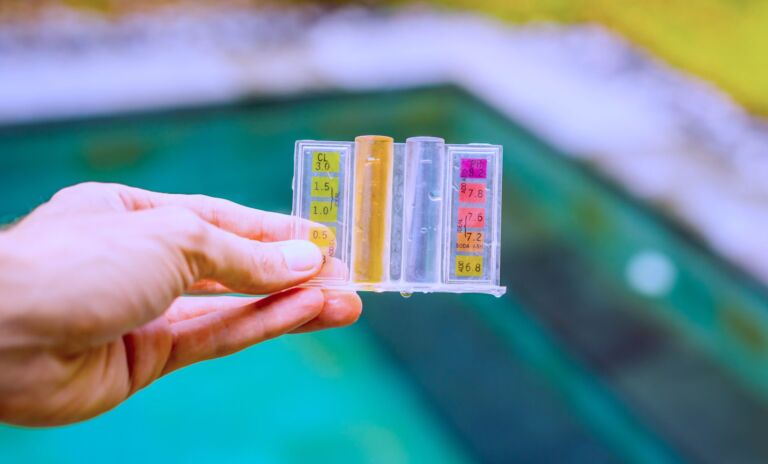
- Balance the water: Bring free chlorine and pH into range and confirm combined chlorine is low before opening (see the testing section below).
- Review your plans: Update your fecal incident response, emergency action plan and staff schedule for peak days.
How often should staff test chlorine and pH at a public pool?
Staff should test the disinfectant level and pH at least twice per day, and hourly when the pool is in heavy use, according to the CDC’s guidance for public pool operators (CDC, 2025). The same guidance sets these targets for pools:
- Free chlorine of at least 1 ppm, without going over the manufacturer’s upper limit
- pH between 7.0 and 7.8
For combined chlorine, the CDC notes that most city, county and state health departments limit it to 0.4 ppm or less (CDC, 2025). Always follow your state or local pool code, which may set different numbers.
What training does pool staff need before opening day?
Pool staff need training on water testing, chemical handling and what to do when something goes wrong. The CDC recommends that operators get the operator and chemical handling training their state or local authority recommends, and that trained operations staff are on hand during weekends, when pools are used most (CDC, 2025).
Before the season starts, walk lifeguards and front-desk staff through:
- How to read test results and when to call the operator
- The fecal incident response and when to close the pool
- How to enforce the shower rule and other pool rules politely
- Where chemicals are stored and why only trained staff go there
Is chlorine enough to protect swimmers from Crypto?
Chlorine alone does not quickly kill Crypto, which is why the CDC stresses that Crypto can survive in properly treated water for more than 7 days. The CDC notes that UV and ozone systems are also known to kill Crypto (CDC, 2025). This is one reason aquatic facilities add supplemental treatment.
Clear Comfort’s hydroxyl-based AOP is one supplemental option that works alongside the required chlorine residual. In a 2014 University of Colorado Boulder lab study, it inactivated up to 99.99% (4-log) of Crypto by the 60-minute sample, under lab conditions in test water rather than pool water (University of Colorado Boulder study, 2014). Supplemental treatment does not replace chlorine, testing or a fecal incident plan.
For a full prevention plan, see How to Prevent Recreational Water Illnesses at a Public Pool: 12 Steps for Aquatic Facilities.
How can you teach members healthy swimming habits?
Members who know a few simple habits keep a lot of germs and dirt out of the water. Build your messages around the CDC’s steps for swimmers (CDC, 2025):
- Stay out of the pool if you have diarrhea
- Shower for at least 1 minute before you get in the water
- Don’t swallow the water
- Take kids on bathroom breaks and check diapers every hour
Ways to share these steps with members before and during the season:
- Newsletter article: Explain why showering first matters, why sick swimmers should stay home and how pee in the water forms the irritants behind red eyes and the “chlorine smell” (see what chloramines are).
- Locker room signs: Post “shower before you swim” and “stay out if you have diarrhea” signs where swimmers change.
- Lifeguard reminders: Ask lifeguards to remind swimmers about the shower rule.
- Pool-only footwear: Encourage members to wear sandals that they only use at the pool, so shoes worn outside do not track dirt onto the deck.
- A poolside kickoff event: Hold a short Q&A on healthy swimming at the start of the season. May is National Water Safety Month (NRPA, 2021), and the CDC has promoted an annual Healthy and Safe Swimming Week in late May (CDC, 2016).
Frequently asked questions
How often should a public pool test chlorine and pH?
A public pool should test chlorine and pH at least twice per day and hourly when the pool is in heavy use, according to the CDC. State and local pool codes may require more frequent testing. Record every result so staff can spot problems early.
What is the minimum free chlorine level for a public pool?
The CDC’s guidance for public pools calls for free chlorine of at least 1 ppm and a pH between 7.0 and 7.8. Your state or local pool code may set different limits, so check it before opening. Combined chlorine is usually limited to 0.4 ppm or less.
What should swimmers do before getting in a public pool?
Swimmers should shower for at least 1 minute before getting in and stay out of the water if they have diarrhea. The CDC also asks swimmers not to swallow pool water and to take kids on bathroom breaks every hour. These steps keep germs and dirt out of the water.
Does chlorine kill Crypto?
Chlorine does not kill Crypto quickly. The CDC says Crypto can survive in properly treated water for more than 7 days, so some aquatic facilities add supplemental treatment such as UV, ozone or Clear Comfort’s hydroxyl-based AOP alongside the required chlorine residual.
See how Clear Comfort supports aquatic facilities with supplemental, low-chlorine water treatment.