
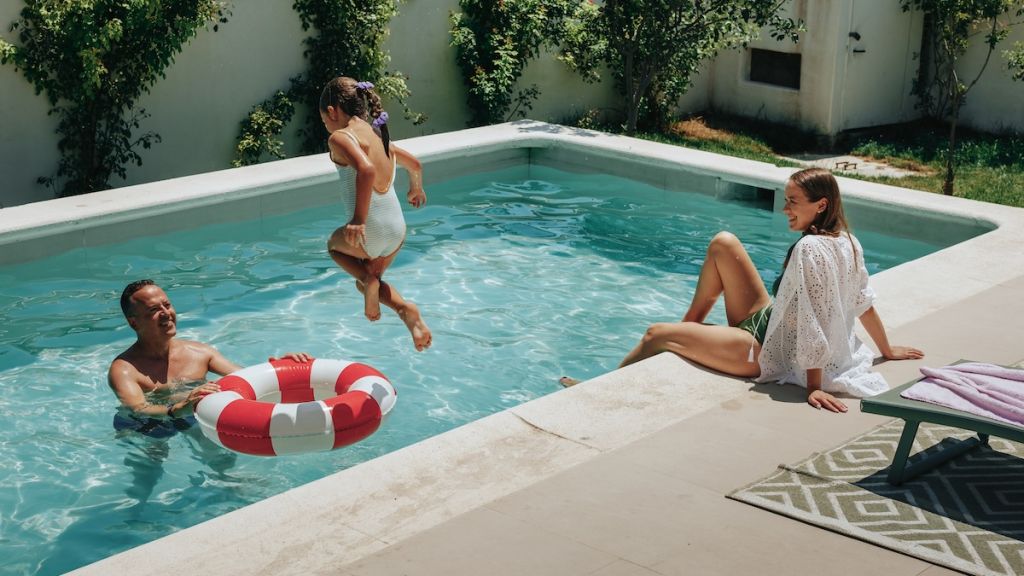
The best pool temperature for most home pools is between 78°F and 86°F. Harvard Health cites that range as the World Health Organization’s recommendation for comfortable, safe swimming at moderate activity. Where you land in it depends on who’s swimming, what they’re doing, your local weather, and how much you want to spend on heating.
Ask five people what the ideal pool temperature is and you’ll get five different answers. Your kids want it warm enough to jump in without hesitating. You might want it cool enough for a real workout. And whoever pays the heating bill wants it as low as everyone will tolerate. Here’s how to find the right number for your pool.
Key Takeaways
- Most home pools are comfortable between 78 and 86°F.
- Lap swimmers do best around 78 to 82°F. Young kids and older swimmers usually want the mid 80s or warmer.
- Treat water below 70°F with caution, and keep hot tubs below 104°F.
- Each degree you add can raise heating costs by 10 to 30%.
- Warm water uses up chlorine faster, so plan on testing more often in summer.
What Temperature Should I Keep My Pool At?
For most households, 78 to 86°F is the right range. If your pool gets a mix of uses, start in the low to mid 80s and adjust a degree at a time from there.
That starting point matches how shared pools handle the same problem. U.S. Masters Swimming notes that multipurpose pools serving everyone from lap swimmers to water fitness classes are usually kept between 83 and 86°F.
Body heat is why one number doesn’t work for everyone. Someone swimming hard produces plenty of their own heat, which is why Mayo Clinic recommends cooler water for higher-intensity exercise and warmer water for people who are frail or dealing with joint pain.
Set your pool for whoever uses it most, then adjust. If the exercise-focused swimmers keep asking for cooler water and everyone else wants it warmer, move the temperature a degree or two at a time until it fits how your household uses the pool.
What’s the Best Pool Temperature for Family Swimming?
For everyday family use, aim for the low to mid 80s. Go warmer if young kids or older family members spend a lot of time in the water.
Kids lose body heat quickly. For swim lessons, the American Red Cross recommends water of at least 84°F for school-age kids and about 90°F for babies and preschoolers.
Older swimmers often want it warmer too. Mayo Clinic points to 84 to 92°F for people who are frail or have arthritis, and the Arthritis Foundation recommends 83 to 90°F for warm water exercise.
What’s the Best Pool Temperature for Lap Swimming and Exercise?
Cooler water works better for exercise, generally around 78 to 82°F.
Hard swimming generates a lot of body heat, and warm water makes it harder to shed. World Aquatics requires competition pools to stay between 25 and 28°C (77 to 82.4°F), and the American Red Cross recommends about 79 to 82°F for intense activity. Harvard Health also warns that a vigorous workout in warm water can cause your body to overheat.
What’s the Best Pool Temperature for Relaxing and Entertaining?
If your pool is mostly for floating and hanging out, the mid-80s or a little warmer will feel best. Just know that every extra degree shows up on your heating bill.
The less you move, the warmer the water needs to be to feel comfortable, according to the Arthritis Foundation. The tradeoff is cost: the U.S. Department of Energy estimates each degree you raise the temperature adds 10 to 30% to energy costs, depending on where you live. Turning the heater down when you won’t swim for a few days and covering your pool both help.
Best Pool Temperature at a Glance
| Who’s Swimming | Temperature Range | Source |
| Most swimmers, moderate activity | 78 to 86°F | WHO, via Harvard Health |
| Lap swimming and hard exercise | About 78 to 82°F | World Aquatics, American Red Cross |
| Mixed family use | 83 to 86°F | U.S. Masters Swimming |
| School-age kids | 84°F and up | American Red Cross |
| Babies and preschoolers | About 90°F | American Red Cross |
| Older swimmers, arthritis, or joint pain | 83 to 92°F | Mayo Clinic, Arthritis Foundation |
| Hot tubs (upper limit) | Below 104°F | WHO, U.S. Masters Swimming |
When Is Pool Temperature a Safety Issue?
Pool temperature becomes a safety issue at both ends of the scale. Hot water can cause overheating and dizziness, and cold water can trigger cold shock.
The World Health Organization advises that people with medical conditions, pregnant women, and young children should avoid temperature extremes.
Is My Pool Too Hot to Be Safe?
The warmer the water and the harder you swim, the higher the risk. Hot water can make blood pressure drop quickly, which can lead to dizziness or fainting.
That’s why U.S. Masters Swimming points to keeping hot tubs below 104°F, and why its open water race limits exist to prevent dehydration, muscle cramps, and heat exhaustion. The same article quotes a physician who says staying hydrated matters more once water climbs past 80°F, especially for anyone with heart issues.
If someone in your household is pregnant, Mayo Clinic suggests water fitness in the 82 to 88°F range. In a warmer pool, drink plenty of water and keep swim sessions shorter.
Is My Pool Too Cold to Be Safe?
Treat any water below 70°F with caution. Below that point, breathing gets harder to control and the strain on your heart goes up.
The National Center for Cold Water Safety says breathing starts to be affected below 77°F and gets progressively harder to control between 70 and 60°F. Most people hit maximum cold shock somewhere between 60 and 50°F. According to U.S. Masters Swimming, water below 70°F raises heart rate and blood pressure, and the risk of cardiac arrest keeps rising in water under 64°F.
People with heart conditions may react more severely to cold shock, according to the National Collaborating Centre for Environmental Health. If your pool feels shockingly cold to get into, that’s your body telling you something useful.
How Does Water Temperature Affect Your Pool?
Warmer water costs more to heat and uses up sanitizer faster. Cooler water is cheaper to maintain, but it’s less comfortable and slows chlorine down.
Warmer water: Every degree adds heating cost, and warm water evaporates faster, which makes the heater work even harder (EPA). Warm water is also friendlier to bacteria, and disinfectants break down faster in it (NCCEH).
Cooler water: Heating costs drop, and chlorine lasts longer. The catch is that chlorine also kills germs more slowly in cold water, so it needs more contact time to do the same job (NCCEH). And fewer people will want to get in.
Testing and maintenance: Test more often during hot stretches and after busy pool days. The CDC has noted that heavy swimmer loads can lower chlorine levels, and warm weather tends to bring both.
How Does Pool Temperature Affect Chlorine and Other Sanitizers?
Warm water makes chlorine break down faster, whether you add it yourself or make it with a salt system, and it holds less dissolved ozone. UV, ozone, and AOP systems all still work alongside a chlorine residual.
For a full side-by-side breakdown, see our chlorine alternative comparison guide.
Chlorine
Chlorine works faster in warm water, but it also breaks down faster, according to the Minnesota Department of Health. Add a summer crowd and levels can drop quickly. Test often during hot weather and adjust your dosing to match.
Salt Chlorine
A salt system makes chlorine, so it faces the same heat-driven demand. Very warm pools need a higher output setting or longer filter run time, and the unit stops generating chlorine altogether when water drops below 50°F. In practice, that means turning output up at the peak of summer and back down when it cools off.
Clear Comfort AOP
Clear Comfort’s AOP injects atomic oxygen into your pool plumbing, where it reacts with the water to form hydroxyl radicals. Those radicals break down contaminants in less than a microsecond and don’t linger in the water. Because the system doesn’t rely on keeping ozone gas dissolved, it isn’t affected by ozone’s drop in solubility as water warms. AOP takes oxidation work off chlorine and runs alongside a chlorine residual.
UV
UV treats water only while it passes through the unit and leaves no residual in the pool, so it has to be paired with chlorine. Cloudy water also reduces how well UV works, according to the NCCEH, so keeping water clear and flow steady matters.
Ozone
As water warms, ozone becomes less soluble and breaks down faster, according to EPA guidance. EPA also found its disinfection rate stays fairly stable across the temperatures studied. Ozone leaves no residual either, and because it irritates the lungs, pools using it need a way to remove leftover ozone gas (NCCEH).
Find Your Pool’s Best Temperature
Start with the 78 to 86°F range, set your pool for whoever uses it most, and adjust a degree or two at a time based on comfort. Keep an eye on the extremes, and turn the heater down when nobody will be swimming for a few days.
A few degrees can be the difference between a pool everyone wants to jump into and one that sits unused, so it’s worth finding your household’s sweet spot.
Noticing your chlorine disappear faster once summer heats up? See how Clear Comfort AOP works and how it can take some of that load off chlorine.