

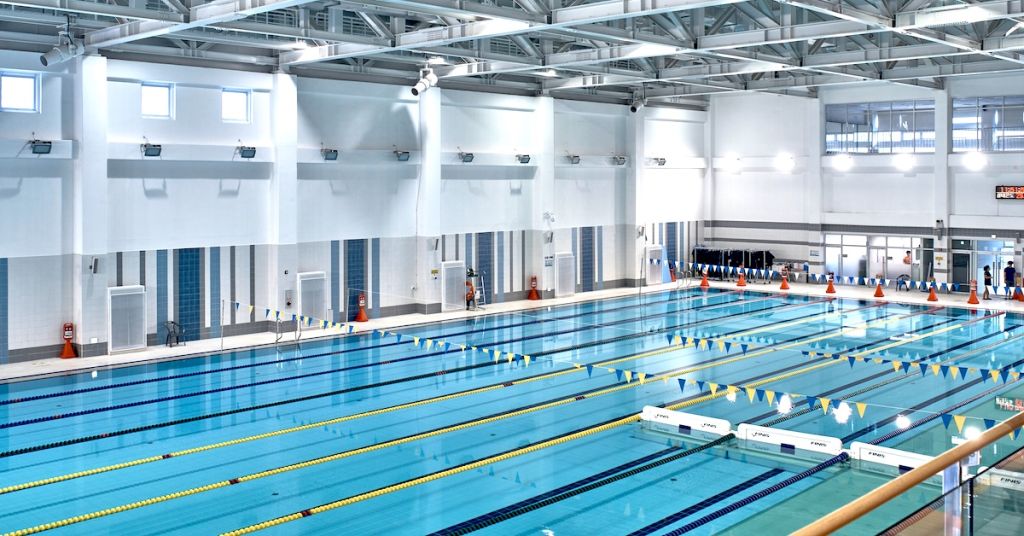
Have you ever wondered about the true Olympic swimming pool size? Or how it compares to other pool sizes? Spoiler alert: it’s likely bigger than your local gym’s pool.
Most people are shocked by the true scale of elite competition pools. Let’s break down the exact dimensions and see how standard pools really compare.
Here is your quick and easy breakdown of the most common sizes:
Quick Answer
How Big Is an Olympic-Sized Swimming Pool?
An Olympic swimming pool is 50 meters long, 25 meters wide and at least 2 meters deep. At that standard depth, it holds approximately 660,000 gallons of water, or about 2.5 million liters. Olympic competition pools typically have 10 lanes, with 8 used for racing and outside lanes serving as buffer lanes.

Pool Size Comparison: Olympic Swimming Pool, 50 Meter 25 Meter, 25 Yard & More
An Olympic swimming pool and other competitive pools are typically measured in meters. For context, one meter equals 3.28 feet. Before you tune in to the Olympics, here is how these different lengths compare.
| Pool Type | Length | Width | Lanes | Temperature | Depth | Typical Use |
|---|---|---|---|---|---|---|
| Olympic Pool | 50 meters (164 ft) |
25 meters (82 ft) |
10, 8 for racing | 25-28°C (77-82°F) |
2 meters (6.6 ft) |
International competitions |
| 50 Meter | 50 meters (164 ft) |
Varies | 8-10 | 25-28°C (77-82°F) |
2 meters (6.6 ft) |
Professional events, training |
| 25 Yard | 25 yards (22.86 m) |
Varies | 6-8 | 25-28°C (77-82°F) |
1.5-2 meters (5-6.6 ft) |
High school, college competitions |
| 25 Meter | 25 meters (82 ft) |
Varies | 6-8 | 25-28°C (77-82°F) |
1.5-2 meters (5-6.6 ft) |
International competitions, training |
| 33 1/3 Meter | 33 1/3 meters (109.3 ft) |
Varies | 8 | 25-28°C (77-82°F) |
1.5-2 meters (5-6.6 ft) |
Specialized competitions, training |
| 30 Meter | 30 meters (98.4 ft) |
20-25 meters (65.6-82 ft) |
None | 25-28°C (77-82°F) |
1.8 meters (5.9 ft) |
Water polo, training |
The Olympic Swimming Pool
An Olympic-sized pool is the gold standard for competitive swimming, recognized by World Aquatics, formerly known as FINA. Olympic-sized pools are used for international competitions, including the Olympic Games, World Championships and other elite events. Because the pool is 50 meters long, swimmers complete two lengths to cover 100 meters.
How Big is an Olympic Swimming Pool?
An Olympic swimming pool is 50 meters long, 25 meters wide and at least 2 meters deep. A standard Olympic-sized pool has 10 lanes, with each lane measuring 2.5 meters wide. In competition, the center 8 lanes are typically used for racing, with outside lanes serving as buffer lanes.
- Length: 50 meters
- Width: 25 meters
- Depth: 2 meters / 6.6 feet
- Volume: Approximately 660,000 gallons (2,500 cubic meters)
- Liters: Approximately 2.5 million liters
- Lanes: 10, with 8 typically used for racing
- Lane Width: 2.5 meters / 8.2 feet
- Typical Use: International competitions, including the Olympics
- Temperature: Typically 25-28°C / 77-82°F
How Many Gallons Are in an Olympic-Sized Pool?
Using the standard dimensions above, an Olympic swimming pool holds approximately 660,000 gallons of water, or about 2.5 million liters.
The exact amount can vary because some Olympic competition pools are deeper than 2 meters to reduce wave turbulence and support faster racing conditions. Deeper pools will hold more water than the standard estimate.
Is a 50-Meter Pool the Same as an Olympic-Sized Pool?
Not always. An Olympic swimming pool is a type of 50-meter pool, but not every 50-meter pool meets full Olympic competition standards.
A true Olympic-sized pool is 50 meters long, 25 meters wide and at least 2 meters deep. Many long-course pools are 50 meters long, but their width, lane count, depth or setup may vary. That means a pool can be used for long-course swimming without being a full Olympic-standard competition pool.
50-Meter Pool
Long Course Swimming Pool (LCM)
A 50-meter pool, also known as a long course meter (LCM) pool, is used for long-course competitions, professional training and high-level swim meets. Ideal for training and professional events, these pools require fewer turns, helping swimmer performance. Typically, both a 50-meter pool and an Olympic-sized pool share the same dimensions. While a 50-meter pool is also considered an “Olympic-sized pool,” the term specifically refers to pools that meet the stringent standards set by World Aquatics, formerly known as FINA.
How Big is a 50-Meter Pool?
- Dimensions: 50 meters long, typically 25 meters wide, but can vary
- Depth: Usually 2 meters / 6.6 feet
- Volume: Approximately 660,000 gallons / 2,500 cubic meters
- Lanes: 8 to 10 lanes
- Lane Width: 2.5 meters / 8.2 feet
- Typical Use: Professional events, training and summer swim club competitions
- Temperature: Typically 25-28°C / 77-82°F
25-Yard Pool
Short Course Swimming Pool (SCY)
A 25-yard pool, or a short course yards (SCY) pool, is common for high school and college competitions in the United States. The U.S. is the only country that doesn’t use the metric system, so it’s the only country that has regulated 25-yard pools for these swimming competitions. Neighborhood HOA pools, recreation pools and National Collegiate Athletic Association (NCAA) competition pools are typically 25-yard pools. Additionally, 25-yard pools are shorter than both 50-meter and 25-meter pools. A 25-yard pool requires swimmers to complete more turns, which can impact race strategies.
How Big is a 25-Yard Pool?
- Dimensions: 25 yards long / 22.86 meters, typically varies in width (45 to 75 feet)
- Depth: Typically 1.5 to 2 meters / 5 to 6.6 feet
- Volume: Varies
- Lanes: 6 to 8 lanes
- Lane Width: 2.5 meters / 8.2 feet
- Typical Use: High school, college competitions, neighborhood pools
- Temperature: Typically 25-28°C / 77-82°F
25-Meter Pool
Short Course Swimming Pool (SCM)
While meters and yards may seem similar in length, competitive swimmers consider them very different. A 25-meter pool, or short course meters (SCM) pool, is slightly longer than a 25-yard pool and is used in international competitions and training. Swimmers need to complete twice as many lengths in a 25-meter pool compared to a 50-meter pool or an Olympic-sized pool. These pools allow for more turns, making them unique in training and racing.
How Big is a 25-Meter Pool?
- Dimensions: 25 meters long / 82 feet, typically varies in width (10 to 25 meters)
- Depth: Typically 1.5 to 2 meters / 5 to 6.6 feet
- Volume: Varies
- Lanes: 6 to 8 lanes
- Lane Width: 2.5 meters / 8.2 feet
- Typical Use: International competitions, training
- Temperature: Typically 25-28°C / 77-82°F
33 1/3 Meter Pool
The 33 1/3 meter pool is less common but used for some competitive events and specialized training. Its unique length allows for exactly three lengths to cover 100 meters. It offers a middle ground between 25-meter and 50-meter pools. Additionally, 33 1/3 Meter pools provide a unique training environment. Swimmers practice turns more frequently than in a 50-meter pool, while experiencing longer swim lengths than in a 25-meter pool. Ideal for honing pacing, turn techniques and stamina, 33 1/3 meter pools are versatile for various training regimens and competitive events.
How Big is a 33 1/3 Meter Pool?
- Dimensions: 33 1/3 meters long / 109.3 feet, typically varies in width
- Depth: Typically 1.5 to 2 meters / 5 to 6.6 feet
- Volume: Varies
- Lanes: Usually 8 lanes
- Lane Width: 2.5 meters / 8.2 feet
- Typical Use: Specialized competitions, training
- Temperature: Typically 25-28°C / 77-82°F
30-Meter Pool
Water Polo Swimming Pool
A 30-meter pool is primarily associated with water polo. They often do not have traditional swimming lanes but are marked for water polo play, including the goal line, halfway line, 2-meter line and 5-meter line.
How Big is a 30-Meter Pool?
- Dimensions: 30 meters long / 98.4 feet, typically 20 to 25 meters wide
- Depth: Minimum 1.8 meters / 5.9 feet
- Volume: Varies
- Lanes: None (marked for water polo)
- Lane Width: Not applicable (marked for water polo)
- Typical Use: Water polo, training
- Temperature: Typically 25-28°C / 77-82°F
Comparing Pool Sizes
Understanding these different pool sizes helps appreciate their unique benefits. Each pool type offers distinct challenges and training opportunities. Whether it’s the fewer turns of a 50-meter pool or the strategic turns in a 25-yard pool, each has its own appeal.
To differentiate pool sizes for swimming times, here are the three top types of competitive pools:
- Long Course Meters (LCM): For 50-meter pools.
- Short Course Yards (SCY): For 25-yard pools.
- Short Course Meters (SCM): For 25-meter pools.
For example, a swimmer competing internationally will have three different times for a 100 freestyle event: an LCM, SCY and SCM time. There are world records for SCM and LCM races but only U.S. records for SCY events.
Why Pool Size Matters for Water Treatment
Pool size affects more than race format. It also impacts water volume, bather load, chemical demand, turnover, filtration needs and indoor air quality.
An Olympic-sized pool holds hundreds of thousands of gallons of water, which means small water-quality issues can become large operational challenges. High bather loads, heavy training schedules and competitive events can increase contaminants such as sweat, body oils and organic waste. When those contaminants react with chlorine, they can contribute to combined chlorine or chloramines, chlorine odor and swimmer irritation.
For competition pools, maintaining clear water and healthy air is not just about appearance. It supports swimmer comfort, facility reputation and day-to-day operational efficiency.
Why Chlorine Alone Cannot Handle Competition Pools
Have you ever wondered why lap pools irritate your eyes, skin, hair and swimsuits more than lakes? It happens because crowded pools push basic chlorine and salt systems past their limits. Swimmers constantly introduce massive amounts of sweat and oils into the water.
When chlorine reacts with that sweat, lotions, oils, etc. in water, it creates harmful chemical byproducts called chloramines (combined chlorine). Chloramines are the actual cause of burning eyes, itchy skin, and ruined swimsuits. They also create that harsh bleach smell and heavily degrade indoor air quality. Basic chlorine and salt simply cannot prevent or lower combined chlorine on their own.
Ensuring true swimmer health means protecting the water far beyond chlorine or salt alone. To protect athletes from things chlorine can’t handle, elite facilities require advanced solutions. That is why top Olympic and university competition pools use Clear Comfort AOP (advanced oxidation process).
How to Swim With a Freshwater Feel
The award-winning Clear Comfort AOP pool treatment is the easiest path to safe, healthy water and air quality. It acts as a powerful secondary and supplemental sanitizer. The AOP system works alongside chlorine, salt, or bromine to drastically minimize your overall chemical use.
Powered by a patented Hydroxyl-Based AOP, Clear Comfort creates hydroxyl radicals. These are the most powerful oxidizers available for recreational water treatment. They protect swimmers by destroying unwanted contaminants chlorine alone can’t, without the irritating effects of combined chlorine.
Whether operating an Olympic swimming pool or a 25-yard pool, the low-chlorine Clear Comfort AOP systems allow you to:
- Enhance Swimmer Health and Comfort: Embrace the healthiest way to swim with water that soothes your eyes, skin and breathing.
- Improve Air Quality: Lower harmful combined chlorine helps reduce chlorine odor, irritation, asthma triggers and chlorine cough.
- Maintain Crystal-Clear Water: Clear Comfort AOP systems keep water consistently crystal clear, appealing for swimming competitions.
- Uncompromised Swimmer Protection: Proven to protect from chlorine-resistant illnesses, like Cryptosporidium.
Additionally, Clear Comfort AOP systems are proven on pools, spas, water parks, splash pads and more. The technology has also been verified by the U.S. General Services Administration. A Department of Energy and NREL study confirmed its massive water and chemical savings. Today, top universities, major professional sports teams’ hydrotherapy training, swim schools and waterparks trust Clear Comfort for elite protection.
Key Takeaways for Olympic and Other Pool Sizes
An Olympic swimming pool is 50 meters long, 25 meters wide and at least 2 meters deep, holding approximately 660,000 gallons of water or 2.5 million liters. Other competition pool sizes, including 50-meter, 25-yard, 25-meter, 33 1/3-meter and 30-meter pools, each serve different racing, training and aquatic facility needs.
For facility operators, pool size is more than a measurement. Larger competition pools carry higher water volume, heavier bather loads and greater water-quality demands – making the right treatment approach essential for swimmer comfort, air quality and day-to-day operations.
Choose the Right Pool Treatment for Your Facility
Looking for the best way to protect your aquatic facility’s time, budget and swimmers? Compare chlorine-only, UV and Clear Comfort AOP pool treatment to see which option better supports water quality, air quality and easier day-to-day operations.
Updated: July 7, 2026. Originally Published: August 23, 2017.

Gabrielle Palumbo
Marketing Director