
Drought Covers About Half of the Lower 48, and Plenty of It Is East of the Mississippi
Cooling towers in drought can face tighter water supplies, higher costs and greater operating risk, even at facilities east of the Mississippi. Yet when drought makes the news, the story usually heads west: the Colorado River, Lake Mead, California and Arizona. That attention is deserved. Western water scarcity is real and well documented. But all that focus can leave industrial teams in the East with the impression that drought is somebody else’s problem.
The numbers this fall tell a different story. Recent rain has eased drought across much of the West and Southern Plains, relief in the East has been patchy, and drought kept spreading across the Lower Mississippi River Basin, the Lower Midwest, and Tennessee in late October.
If you work in operations, EHS, engineering, sustainability, or plant leadership at a water-dependent facility east of the Mississippi, this post covers where drought stands right now, how drought affects industrial facilities and their cooling towers, and how to plan ahead while you have the most options.
Is the Eastern U.S. in a Drought Right Now?
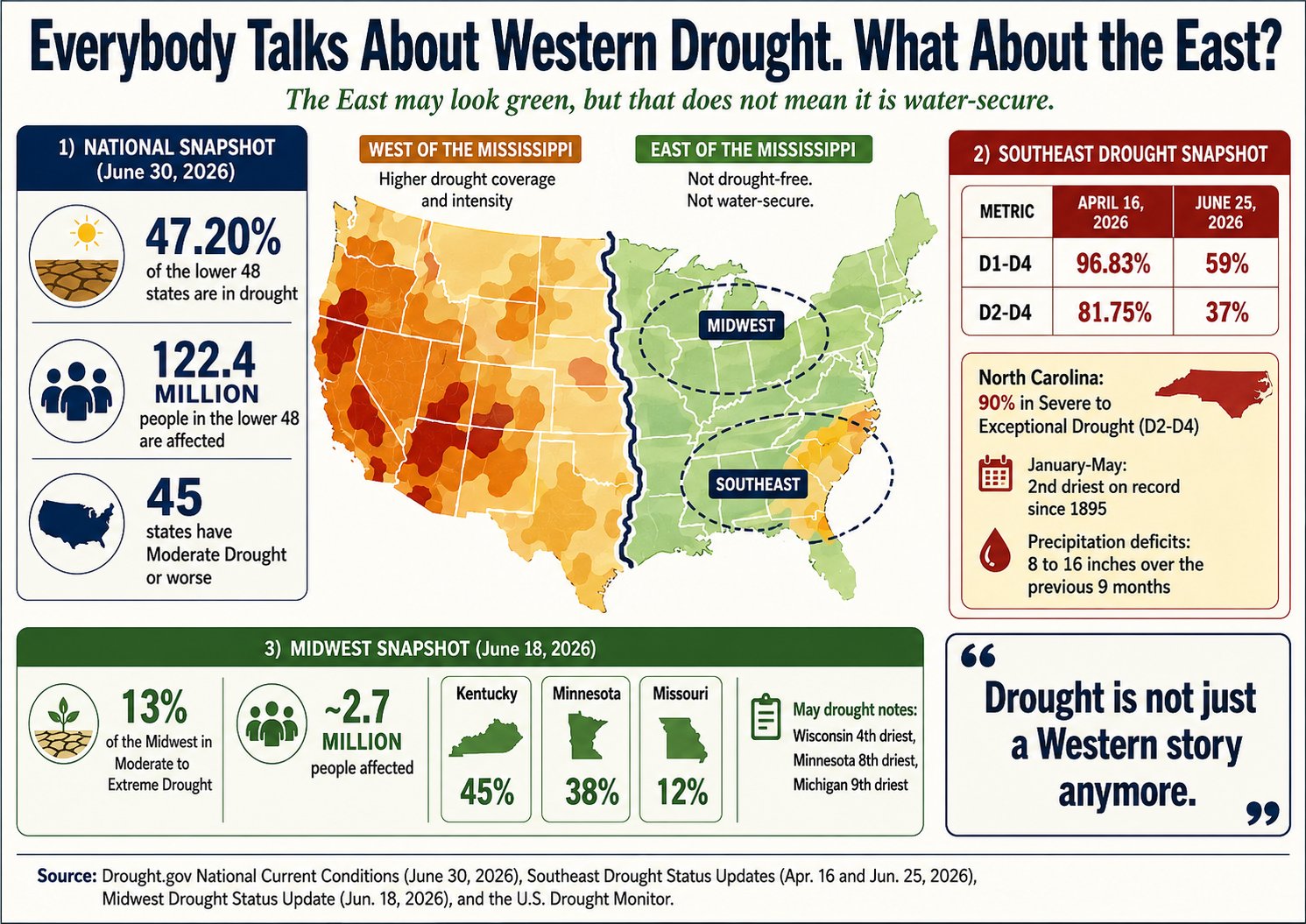
Yes, large parts of it are. As of October 27, 2026, 49.5% of the Lower 48 states were in drought, according to Drought.gov. That week, most of the eastern half of the country got little or no rain, and drought worsened across the Lower Mississippi River Basin, the Lower Midwest, and Tennessee.
The national number has moved a lot this year. About 48% of the Lower 48 was in drought at the end of June, and coverage passed 59% by the end of September. It fell back to just under half by late October as heavy rain, much of it from the remnants of Hurricane Polo, eased drought across the Southwest and Southern Plains. Most of that relief landed west of the Mississippi.
How Is Drought Measured?
The U.S. Drought Monitor ranks drought from D1 (Moderate) to D4 (Exceptional) and defines it as a moisture shortfall serious enough to create social, environmental, or economic effects. For a facility, drought becomes a business issue once it starts touching water supply, operating reliability, costs, compliance, or long-term planning.
How Bad Is the Drought in the Southeast?
This spring, the Southeast had its most widespread drought since the U.S. Drought Monitor began in 2000, and parts of the region are still in it. North Carolina has been hit especially hard.
A Record-Setting Spring
In mid-April, Moderate to Exceptional Drought covered 96.83% of the Southeast, and Severe to Exceptional Drought covered 81.75%, the largest drought footprint for the region in the Drought Monitor’s history. The same update reported that Georgia, North Carolina, and South Carolina all had record dry conditions from September 2025 through March 2026, in records going back to 1895.
Where Conditions Stand This Fall
Conditions eased in parts of the region over the summer, but the drought never fully cleared out. In mid-October, Hurricane Isaias dropped nearly 10 inches of rain on parts of western North Carolina, and drought eased across the mountains. Much of the rest of the state saw less relief. As of October 20, half of North Carolina was still in drought, according to NC DEQ. Extreme drought held along the Virginia border, conditions worsened in the Coastal Plain and northern Piedmont, and streamflows on the Tar River fell below the 10th percentile.
El Niño has also taken hold. NOAA’s Climate Prediction Center reported in early October that it was still strengthening, with a strong to very strong event likely through early 2027. El Niño winters tend to be wetter across the Southeast, which could help. Still, one wet season won’t refill groundwater or reset a facility’s water risk overnight.
The Southeast is home to data centers, power plants, chemical and food processing operations, and a lot of manufacturing that runs on reliable water. Many of these facilities don’t think of themselves as drought-exposed, and the exposure tends to build gradually.
Is the Midwest in a Drought?
Parts of it are. Drought worsened across the Lower Mississippi River Basin and the Lower Midwest in late October, according to Drought.gov, even as much of the country to the west improved. Farther north, moderate to severe drought continued into October in parts of Wisconsin and Minnesota, according to the National Weather Service.
That matters because the Midwest is one of the country’s major industrial corridors. Refining, chemicals, plastics, food processing, power generation, and data infrastructure all depend on steady process water, wastewater discharge capacity, and stable municipal or surface water supplies.
How Does Drought Affect Industrial Facilities and Cooling Towers?
Drought usually reaches industrial facilities through costs, permits, intake conditions, and sustainability pressure, often well before anything looks dry from the road. Here’s where Eastern facilities tend to feel it first:
- Water and sewer costs. Utilities under stress often raise rates or add surcharges, and high-volume users feel those increases the most.
- Withdrawal and discharge limits. Lower streamflows can mean tighter permits and less room for discharge.
- Warmer, lower intake water. Lower flows tend to run warmer, which makes cooling less efficient right when supply is tight.
- Sustainability targets and visibility. Corporate water-reduction goals, community attention, and customer questions all get louder during drought.
Why Is Drought Easy to Miss in the East?
In the West, drought shows up in reservoirs, restrictions, and headlines. In the East, it can still rain, the grass can stay green, and rivers can keep flowing, so it doesn’t always feel like drought. Industrial water risk comes down to whether a facility can keep running reliably while meeting cost, compliance, and sustainability expectations, and that can get harder long before the landscape changes.
How Can Industrial Facilities Prepare for Drought?
Start by finding your biggest water users and asking how the facility would run with less water. Eastern facilities have one advantage right now: time. Water planning goes much smoother on your own schedule than in response to a rate hike or a permit change. A few questions worth bringing to your operations, EHS, engineering, and sustainability teams:
- If drought conditions continue into next year, can we keep production on track with less water?
- Where are our biggest water users, and how much of that water leaves the site as blowdown or discharge?
- How exposed are we to water and sewer rate increases?
- Do we have water-reduction goals, and are we on pace to hit them?
For many facilities, the cooling tower is one of the largest water users on site, which makes it a practical place to start. Cooling tower treatment that reduces blowdown can cut water use without changing how the plant produces.
In a federal evaluation, Clear Comfort’s cooling tower AOP delivered 26.3% modeled makeup-water savings and reduced annual O&M labor hours by 50%. These results show how better cooling tower treatment can support water-reduction goals without disrupting operations.
Frequently Asked Questions
What Percentage of the U.S. Is in Drought?
As of October 27, 2026, 41.4% of the United States and Puerto Rico and 49.5% of the Lower 48 states were in drought, according to Drought.gov. The U.S. Drought Monitor updates these numbers every Thursday.
Can Drought Affect Facilities in Regions That Get a Lot of Rain?
Yes. The Southeast usually gets plenty of rain, and in spring 2026 it still had its most widespread drought since the U.S. Drought Monitor began in 2000. Facilities there can feel drought through higher water costs, tighter permits, and lower streamflows even when the area looks green.
What Is the U.S. Drought Monitor?
The U.S. Drought Monitor is a weekly national map of drought conditions, jointly produced by the National Drought Mitigation Center, NOAA, USDA, and NASA. It ranks drought from D1 (Moderate) to D4 (Exceptional).
Which Industries Are Most Affected by Drought?
Water-intensive operations feel it most, including power generation, data centers, chemical production, food and beverage processing, pulp and paper, and refining. Any facility that depends on cooling towers or large volumes of process water has exposure.
How Can a Facility Reduce Cooling Tower Water Use?
Most cooling tower water is lost to evaporation and blowdown. Running the tower at higher cycles of concentration reduces how much water must be bled off and replaced, lowering total water use. Water treatment that allows higher cycles is one of the most direct ways to get there.
Why Eastern Facilities Should Plan for Less Water
The Western drought story is real, and the East now has one of its own. The Southeast is coming off a record drought that still hasn’t fully cleared; drought keeps spreading along the Lower Mississippi River, and about half of the Lower 48 was still in drought at the end of October.
For industrial facilities east of the Mississippi, there’s still room to plan. Making water efficiency part of today’s operating strategy, starting with the systems that use the most, puts your facility in a stronger position no matter what next year’s weather brings.
See What Your Cooling Towers Could Save
Estimate your potential water, chemical and operating cost savings with Clear Comfort.

Doug White
VP of Business Development