

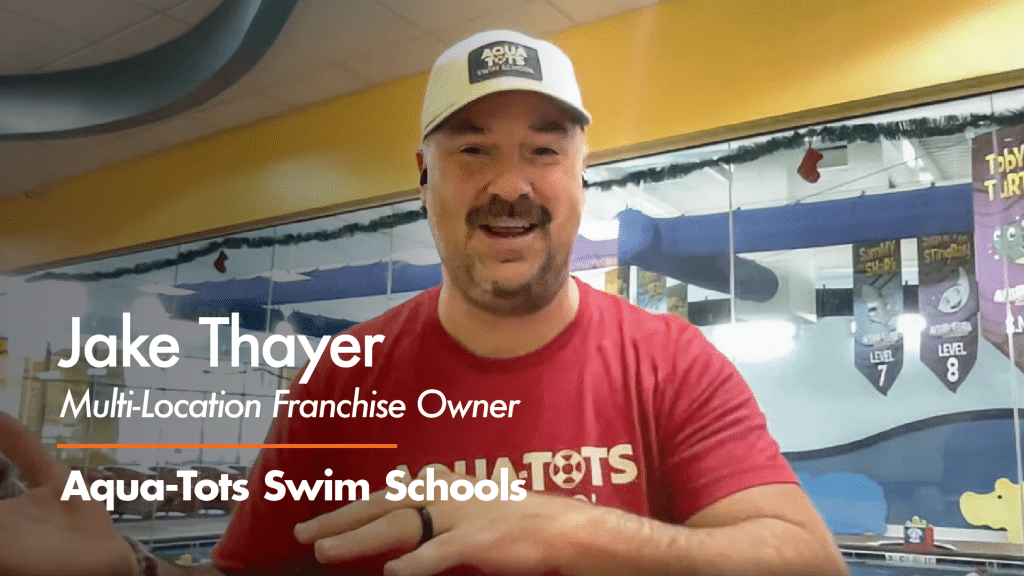
How an Aqua-Tots franchise owner traced his pool’s compliance problem back to the city water supply – and what fixed it.
Managing pool chemistry is hard enough when all the variables are yours to control.
But what happens when the problem walks in through your fill line every single day – and you don’t even know it?
That was Jake Bayer’s situation. He owned Aqua-Tots Swim Schools franchises in Lexington, Louisville, and Indianapolis. His team was doing everything right. The chemistry still wasn’t.
What he discovered – and how he fixed it – is something every indoor aquatic operator needs to understand.
Chloramine Red Flags That Didn’t Add Up
Jake’s team was monitoring chemistry carefully, working alongside the health department, and adjusting treatment regularly. The numbers still wouldn’t cooperate.
Chloramines or combined chlorine form when pool chlorine reacts with contaminants like lotions, sweat, urea, etc. This disinfection by-product is the real source of that “pool” chemical smell, red eyes, irritated skin and poor indoor air quality.
“The chemistry didn’t make sense to us,” said Jake. “Until we discovered that the city water system uses chloramines.”
The culprit turned out to be invisible – and it was arriving before a single swimmer ever got in the water.
The Real Problem: Chloramines in the City Water Supply
A growing number of U.S. cities add ammonia to drinking water. This forms monochloramines, a more stable disinfectant for distribution systems. Nearly 30% of community water systems now use chloramine treatment. Projections suggest this will reach 55% of U.S. surface water systems. This change is expected as stricter EPA standards take effect.
That’s fine for a glass of water. It’s a serious problem for a closed pool system.
Jake’s tap water tested chloramines between 1.5 and 3.5 ppm, well within the EPA’s 4 ppm drinking water limit. As Jake put it, that’s water “safe to drink, safe to wash your produce, safe to bathe your child in.” But when that same chloramine level entered a closed pool system, it flagged health department violations. His team could not prevent them with chlorine alone.
“We could show the data that we were lowering it,” Jake said. “But we weren’t getting it where the health department wanted. ‘These are our rules. These are our regulations. Tough cookies. Figure it out.'”
Why Indoor Aquatic Facilities Take the Hardest Hit
Outdoor pools can off-gas chloramines into open air. Indoor facilities can’t. For swim schools in particular, the stakes are higher. Your pool isn’t just a facility – it’s where infants and toddlers take their first strokes. Parents are trusting you with the youngest swimmers in the water.
In a closed aquatic environment, combined chlorines accumulate in both the water and the air above it. The people who feel it first aren’t the once-a-week swimmers – they’re your instructors and staff.
Eye irritation, itchy skin and heavy chemical smell are classic signs of a chloramine problem. If swimmers or staff are reporting any of these, it’s time to investigate.
How to Fix Pool Chloramines From City Water Supply
Jake consulted pool service partners he’d worked with for nearly a decade. Their answer was immediate: Clear Comfort.
Clear Comfort uses Hydroxyl-Based AOP (advanced oxidation process) as a secondary sanitation layer alongside chlorine. This targets combined chlorines directly and oxidizes excess contaminants that chlorine alone can’t handle.
The results were concrete:
- Balanced, stable water chemistry
- Softer-feeling water for swimmers and instructors
- Reduced combined chlorine levels
- Lower chlorine consumption
- Improved, fresher air quality
“It was just an overall win for our program,” Jake said.
Jake installed Clear Comfort AOP water treatment systems across all three of his Aqua-Tots locations. This included a retrofit on a larger Louisville pool – with no disruption to operations. Jake said it was, “Extremely easy to retrofit. No impact on the space or access in our pump and pool room.”
Whether you run a swim school, recreation center, splash pad or water park, these results can scale to all types of swimming environments.
What Aquatic Operators Should Do Now
1. Test your tap water first
Pull a source water sample before it ever reaches your pool. If your municipality uses chloramine treatment, you’re starting with a chemistry disadvantage every fill cycle.
2. Look up your local water quality report
Most providers publish annual disclosures. Search for “monochloramine” or “chloramine disinfection” – if it’s there, factor it into your treatment strategy.
3. Listen to your staff and swimmers
Swim school instructors, lifeguards, and rec center staff spend hours poolside every day — far longer than any patron. Their feedback is your earliest and most reliable indicator of a water quality problem.
4. Don’t rely on chlorine alone
In enclosed aquatic facilities drawing from chloramine-treated supplies, secondary sanitation isn’t a luxury. It’s the missing layer.
The Bottom Line
Jake’s locations were well-run. Good operators, experienced partners, documented data. And they were still failing health department standards because the problem started upstream – literally.
Start at the tap. Understand what your municipality puts in the water before it reaches your pool. Then build your treatment strategy around the full picture.
“It’s a great product,” Jake said. “We’d buy it again.”
Dealing with persistent combined chlorine issues in your facility? A tap water test may be the first step you haven’t taken yet.

Gabrielle Palumbo
Marketing Director