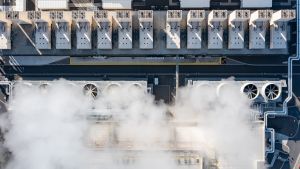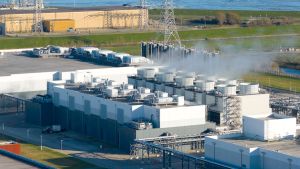

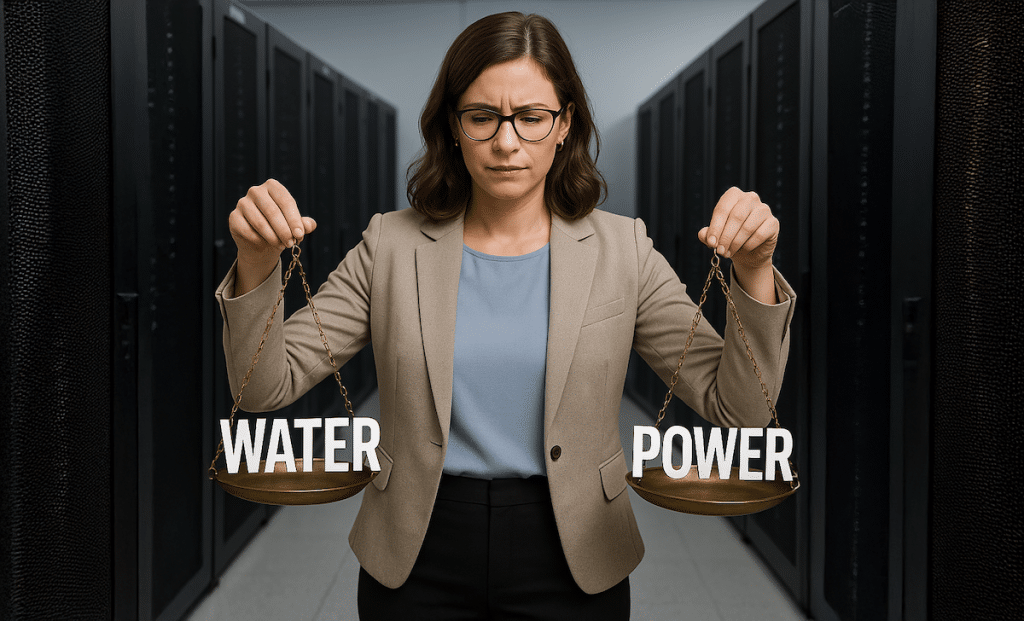
Data centers must balance two critical metrics: PUE (Power Usage Effectiveness) and WUE (Water Usage Effectiveness). Every cooling choice carries a trade-off between data center water usage, energy demand and environmental impact.
The sections below break down the major cooling approaches and where advanced oxidation (AOP) cooling tower water treatment reshapes the equation.
Cooling Towers: Best for Energy, Highest for Water
Evaporative cooling towers remain the most efficient way to reject heat at scale. Water absorbs heat far better than air, allowing towers to deliver strong cooling with minimal compressor or fan load. This low mechanical load supports strong PUE data center performance, especially in large facilities.
The trade-off: towers consume significant water through evaporation and blowdown.
Liquid Cooling: Minimal Water, Moderate Energy
Direct-to-chip and immersion cooling dramatically reduce evaporative losses while enabling higher rack densities. However, these systems still rely on mechanical heat rejection.
The trade-off: lower water use, but higher electrical energy demand compared to evaporative systems.
Air-Cooled Mechanical Systems: Zero Water, Highest Energy
Air-cooled chillers and dry coolers eliminate water consumption entirely.
The trade-off: high compressor and fan energy, especially during hot weather, driving up both operating costs and carbon footprint.
Where AOP Makes the Difference: Reducing Water Without Raising Energy
Evaporation is unavoidable — it’s the physics behind efficient heat transfer. Blowdown, however, is the controllable part of tower water use.
Blowdown volume is directly tied to Cycles of Concentration (COC), which measures how many times water can be reused before it’s discharged due to mineral buildup, biofilm and contamination. Poor water quality forces operators to discharge water earlier and more often.
This is where Clear Comfort’s AOP changes the equation.
Higher Cycles = Lower Water Use
AOP directly reduces cooling tower blowdown by enabling higher cycles of concentration. AOP oxidizes organics, suppresses biofilm and keeps heat-transfer surfaces clean. With more stable, cleaner tower water, operators can safely increase cycles – often from 3 to 4 or 5+.
That improvement typically results in:
- Up to ~25% reduction in total cooling tower water use
- Lower blowdown volume
- Lower makeup water demand
- More consistent thermal performance
And importantly, AOP does this without adding meaningful electrical load, keeping energy efficiency intact.
Cleaner Effluent and a Smaller Environmental Footprint
With biofilm and organics controlled, chemical demand for biocides and scale inhibitors decreases. That means:
- Blowdown water carries fewer pollutants
- Discharge stays within permit limits more easily
- Chemical storage, handling and exposure risks drop
- Overall environmental impact decreases
Data centers not only use less water — they produce cleaner water.
Why This Matters for Data Center Expansion
Communities and regulators are increasingly concerned about:
- Local water availability
- Electrical grid capacity
- Wastewater discharge
- The sustainability of hyperscale growth
AOP allows operators to keep the energy efficiency advantage of cooling towers while drastically reducing cooling tower water use and environmental impact. These gains support stronger PUE performance and better WUE data center metrics. It moves data centers closer to the optimal point where PUE and WUE both perform well, creating a stronger case for responsible, sustainable expansion.
A More Sustainable Cooling Path for the Future
Clear Comfort’s AOP technology gives data centers a way to reduce water demand, lower chemical use and improve reliability — without sacrificing the energy efficiency that keeps operating costs and carbon impact in check.
As the world demands more computing power, solutions like AOP will play a critical factor in building a sustainable data center strategy that communities can support.
Want to explore strategies for improving cooling tower water efficiency?
See additional strategies for cleaner water, higher cycles and more efficient cooling. Read our blog. »

Steve Berens
CEO and co-founder Steve Berens is a skilled executive who brings more than 20 years of experience in strategy, marketing, sales and engineering to Clear Comfort. Prior to Clear Comfort, Steve co-founded Power Tagging, a smart grid company, and was CEO of Privacy Networks. Steve was nominated to serve on the Deming Center Advisory Board as well as the executive advisory board of CU Cleantech.